


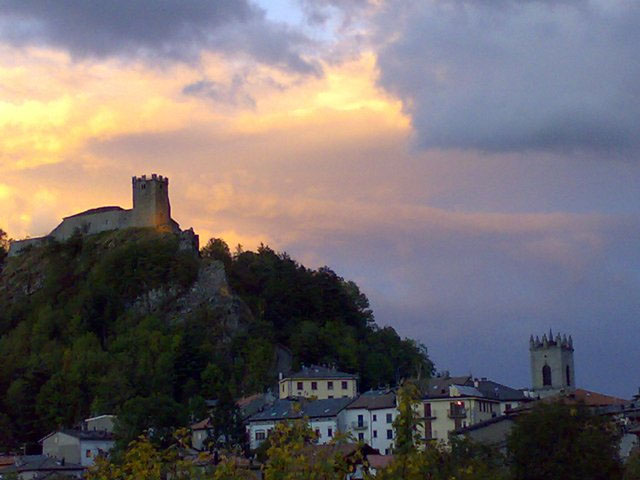
Sestola, the "GREEN PEARL", is the most famous town in the Modenese Apennines, located on the saddle of a buttress perched on the slopes of a cliff surmounted by the ancient fortress.
In its territory, which has an altitude range of 1,841 m. (from 324 of the Panaro river to 2,165 of Monte Cimone, the highest peak of the northern Apennines), Sestola is located in a median position (1,020 m), between the localities ofPian del Falco,Passo del LupoeLake of the Nymphupstream, and the hamlets ofCasine,Castellaro,Rocchetta Sandri,Roncoscaglia,VesaleePoggiorasodownstream, with a total population of 2550 inhabitants.
The center of Sestola (built starting from the 14th century), made up of three main villages (Tanelle, Perocotto, Albaghiccia) enhanced by interesting urban features and guided tours, is inhabited all year round by a thousand villagers, largely tourist vocation, which can reach up to 20,000 in the busiest moments.
Nature, sport, gastronomy, art and culture find in Sestola an adequate response to any type of tourist need which allows us to offer the visitor an ideal holiday in every season.
“GOOD AIR – FLAVORS – STARRY SKIES”
The old part of the town stands close to a high rocky spur on which the ancient fortress stands. Rebuilt in the mid-16th century, it had great strategic importance as it was located in the center of Frignano, guarding the Scoltenna and Leo valleys.
THE FORTRESS
Its written history begins with the conquest of the Lombards: the first document in which its Castle is mentioned is Astolfo's Diploma of 753 AD. with which the Kings of the Lombards donated the Castrum Sextulae and adjacent territories to their brother-in-law Anselmo, founder of the Abbey of Nonantola. At the time of the Municipalities, Sestola joined the Federal Municipality of Frignano. It was then the scene of bitter clashes between the provinces of Modena and Bologna which fought on several occasions for its possession until, in the 14th century, Sestola and Frignano joined the Lordship of the Estensi.
From that moment Sestola became the capital of the Province of Frignano, a title it retained until the beginning of the 19th century. After the restoration of 1815 the town lost its centuries-old importance, following the opening of Via Giardini (now SS. 12 of Abetone and Brenner); consequently the Fortress was transformed into a penitentiary active until the Unification of Italy in 1866. The Castle, abandoned to itself after the closure of the penitentiary, was purchased by the Municipality in 1876 and partly used as a home by needy families from Sesto , by the custodian and by municipal employees. At the beginning of the last century, while the town glimpsed a new and concrete economic identity in the nascent tourism, its Fortress underwent a further transformation by hosting a Meteorological Observatory and a summer institute for the care of children suffering from rickets: this is the first nucleus of the summer and mountain headquarters of the Rachitici Institute of Modena, later dedicated to Umberto I, wanted by Prof. Giuseppe Triani, former President of the Institute and by Prof. Luigi Nasi who chose Sestola for its altitude and the healthiness of its climate favored by the presence of resinous forests and in particular the Fratta pine forest, close to the Castle.
These are the characteristics that contribute to quickly spreading the name of Sestola. The presence of young guests increased from year to year until it reached 120 units in 1913, no longer coming only from the Modena area, but from all of Emilia and Northern Italy. After the last war, the Castle was transformed into a permanent mountain colony until 1987. The Castle, or rather, its Fortress, after the renovation by the Municipality of Sestola, has in recent years become a Multipurpose Cultural Center which hosts some important museums:.
Museum of Mechanical Musical Instruments
set up in the rooms of the Governor's apartment. It exhibits around 130 instruments, all in perfect working order, from the beginning of the 18th century to the present day, from accordions to pianolas, from music boxes to autopianos, proposing the evolution of sound reproduction, from 1877 to the present day, from roll phonographs to phonographs Bakelite disc, from turntables to recorders, from CDs to minidiscs and MP3s.
Museum of Mountain Civilization
set up in the rooms of the former stables and former archive, it displays tools, utensils and materials relating to work and mountain civilization.
Teresina Burchi Museum in Reiter (Sestolese Soprano):
The room of memories: photos, documents, clothes and props of the Sestolese soprano, famous singer and interpreter of Wagner, who sang in the most famous and prestigious theaters around the world from the beginning of the twentieth century until the 1930s: the exhibition aims pay homage to an illustrious fellow citizen.
The Prisons:
in the prisons in the basement and in the entrance hall, headstones, inscriptions, columns and artefacts relating to the history of the Castle and its Municipality are displayed.
Frignano Artists Exhibition:
Sestola pays homage to the Artists of its ancient Province. Inside the castle walls there is the "Parco delle Anime salve", created by the "E' Scamàdul" Cultural Association which, thanks to its valid commitment, now manages the fortress, dedicated to the memory of Fabrizio De Andrè, poet and singer-songwriter, takes the name comes from one of his last songs and consists of the permanent exhibition of 23 texts of his most famous songs. The Park therefore not only words to read and meditate on but also music and concerts to listen to and experience.
THE ORATORY OF THE ROCCA
Documented as early as 1114, this Church was at the service of the fortified village of the Castle, but also of all the inhabitants of the town and the countryside until 1619, when the Parish Church of San Nicolò was inaugurated in the center of the town at the foot of the cliff. The embellishment of the Church of Rocca, towards the end of the 15th century, made this small Oratory one of the most beautiful in the whole mountain, worthy of the prestige of being not only the Parish Church of Sestola, but also the church of a Province of the Duchy Este. Towards the end of the 17th century it was reduced to an oratory; the construction of two new side altars hid from view part of the valuable frescoes painted by Tommaso Ribecchino at the end of the fifteenth century and which only around 1993 were "rediscovered", after three centuries, in a good state of conservation.
THE PARISH CHURCH
Built between 1614 and 1619, it replaced the Oratory of San Nicola in Rocca for liturgical celebrations. The last important renovation, between 1898 and 1902, with the expansion of the Church itself and the façade, produced the current image, and preserves numerous works of art which have now been largely restored.
THE CHURCH OF THE ROSARY
Born as the Oratory of the Annunciation in 1584, it was soon called by its current name. It was smaller in size than it is today and was next to the home of the noble Cavalcabò family from Cremona.
Its expansion to its current form, which took place in the 19th century, included the construction of the adjacent bell tower. The anniversary of the Madonna del Rosario, with the feast dedicated to the Blessed Virgin venerated and represented inside the Church and with the Holy Procession with great participation of the population, falls on the first Sunday of October.
THE ORATORY OF S. ANTONIO DA PADOVA
It is located in the Poggiolino area (along the pavement that leads to the Rocca) in front of the Sisters' nursery school. Built in 1651 by the family. Albinelli, preserves the seventeenth-century painting of the Miracle of St. Anthony. In 1840 the small Temple was renovated to its current shape.
SANCTUARY OF POGGIORASO
Located in the village of Poggioraso, its origins are unknown, but a tradition identifies the image of the Madonna with Child, painted on stone and venerated inside the sacred building, as the protector of the Sestolese community from epidemics, as happened on the occasion of the plague of 1630 leaving the Sestolesi immune.
It was for this reason that the Community named the Oratory after the "Blessed Virgin of Graces" which subsequently attracted large pilgrimages from neighboring countries, especially in the months of May and September. Still venerated as a votive Madonna.
THE BELL TOWER (OR CLOCK TOWER)
The nineteenth-century bell tower, designed by Don Paolo Zona, Chaplain of the Rocca and built on the saddle of the town center between 1853 and 1857, dominates the historic center of the town, an ideal location to send the sound of the bells towards all the villages of the town.
At its feet is the valuable fountain covered by a 17th century loggia.
THE VICTORY SQUARE
Named after the Italian victory in the "Great War" (1914-1918) and inaugurated with the War Memorial in 1929. Theater of the main events of Sestola, it was partially modified in the furnishing elements in the mid-1950s.
The current fountain located in the center of the square and the two "bronzes" inside representing the Leo and Scoltenna streams date back to 1961 and are the work of the Modena artist Vittorio Magelli.