



Monte Cimone is the largest relief in the northern Apennines with a height of 2,165 m. and is part of the territory of the municipalities of Fiumalbo, Sestola, Fanano, Montecreto and Riolunato, in the province of Modena.
It is a mountain with a vague pyramidal shape with three faces, and an anticima called Cimoncino. On the top of the mountain there is a military base, which is why, during the period of the cold war, access to the summit was forbidden, while currently, in summer, it can be reached on foot through paths and ancient mule tracks even from the villages to Valley.
Its profile is a characteristic element of the Modenese Apennine landscape and is visible from the provinces of Modena, Reggio Emilia, Parma, Mantua, Pistoia, Bologna, Pisa, Ravenna, Verona and Vicenza.
Considering the spatial resolution of the human eye, the top of Monte Cimone is the geographical point from which the most Italian surface can be seen. In conditions of excellent visibility, in fact, you can see on the horizon all the Alps, the Adriatic Sea, Mount Amiata, the Argentario, the Tyrrhenian Sea, the island of Elba, Corsica and the island of Capraia.
On the top, consisting of a large esplanade, there are multiple antennas for telecommunications and in particular a radio beacon for air navigation in addition to the meteorological station of the Air Force of Monte Cimone (1936) officially recognized by the world meteorological organization.
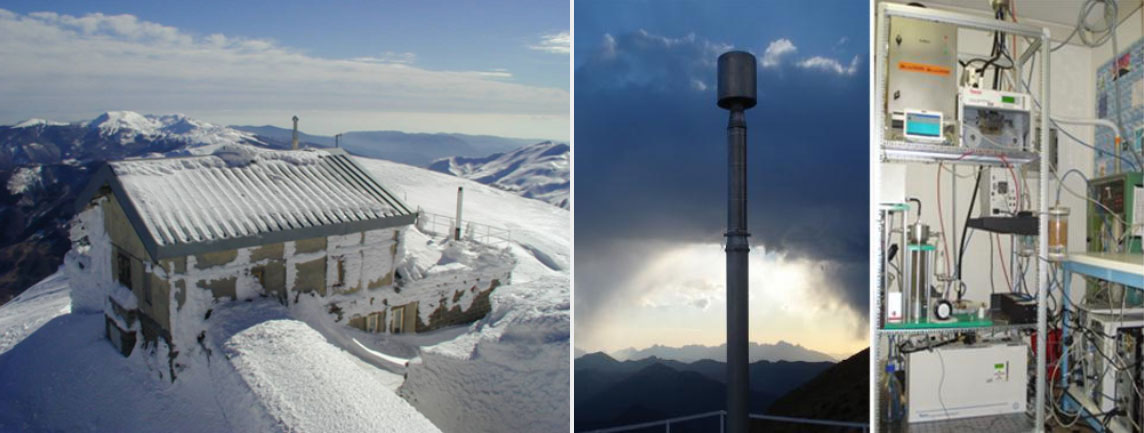
In addition, there is also the "Ottavio Vittori" research station, a scholar physicist who lived most of his professional life (1951-1970) in Sestola, major promoter and head of the Scientific and Experimental Meteorology Observatory created in 1948 and now an Institute of atmospheric and climate sciences of the National Research Council for the study of the atmosphere and climate, considered one of the most important internationally.
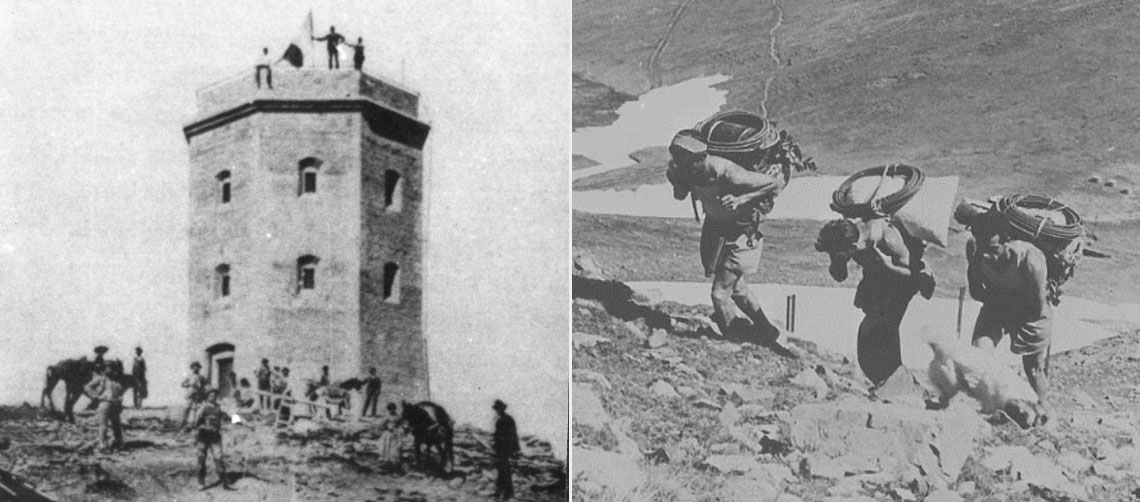
During the excavations for the foundations of the tower / observatory (1852-1893), traces of human presence dating back to the Romans were discovered on the summit, while the first ascents for sporting or scientific purposes are documented starting from 1567.
Several expeditions for the study of pressure and atmospheric composition were made in the seventeenth century, also by the Jesuit Fathers.
In 1908 a chapel dedicated to the Madonna of the snow was built, still venerated with a procession and with the celebration of a mass on 5 August each year.
Another attraction of Mount Cimone is the Ninfa Lake, a lake of tectonic origin that is favored, especially during the summer season, for the enchanting scenery that opens up before the eyes of the hiker. Monte Cimone certainly represents for the District the first sign of its new tourist identity which, since the end of the 19th century, rapidly transforms its economy.
The occasion is the construction on the top of the Tower / Observatory with purposes, to be honest, more scientific than tourist, but they are the "huts", built to house the workers involved in the construction of the same, which welcome hikers who climb the Mount to admire the vast panorama, to continue, in 1945, with the construction of the "Base" of the Air Force.
Guides and porters were employed to transport goods and food to the summit.
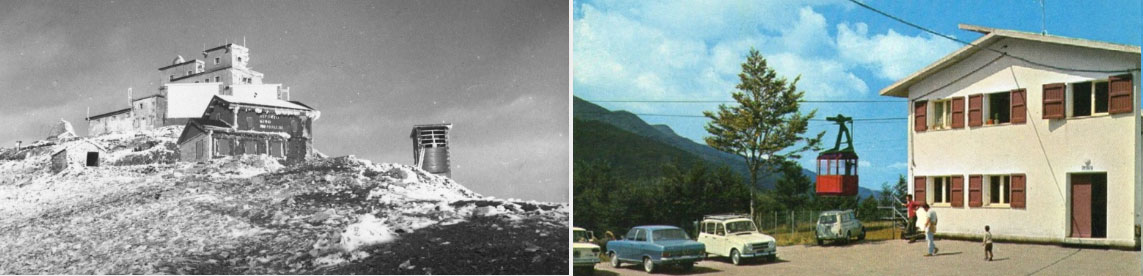
It was a kind of "para-state" work carried out by the most robust and young villagers who, equipped with skis, sealskins and ice crampons, carried on their shoulders, using poles (backpacks), from 30 to 50 kg. of material. The ever-looming danger and the immense fatigue have made the porters one of the legends of Cimone to which the survival of the military on the summit was subordinated.
These "Sherpas" of the Apennines were decisive for the development of winter tourism: it was they who, in fact, were the first, returning to the valley with skis on their feet, to identify the most suitable tracks to become, after a few years, ski slopes, thus opening the road for winter sports enthusiasts towards the Cimone.
In 1949 the first ski lift was built, the Sestola-Pian del Falco chairlift, which was followed, in the 1950s, by the extension of the Sestola - Pian Cavallaro forest road and a tunnel to reach the top and in 1966 the construction of the Passo del Lupo - Pian Cavallaro cableway for the winter connection of men and vehicles.
Today there is the most important ski resort in Emilia Romagna, called the Monte Cimone District. The district is divided into various locations including the municipalities of Sestola, Fanano, Montecreto and Riolunato, all connected to each other by various connections. The slopes extend for a total of 50 km. and, unlike the other Apennine slopes, its width is much greater than normal.
The Cimone with its presence, its history, its resources is now a symbol that unites all the people of our mountains and that, together with the cultural emergencies of Romanesque art as well as the love for bel canto, the genuine gastronomy , to the entrepreneurship of our people, contributes to the overall image of the District and strengthens the national and international tourist offer.
A sentinel of the sky to guard the past and to know the future.