


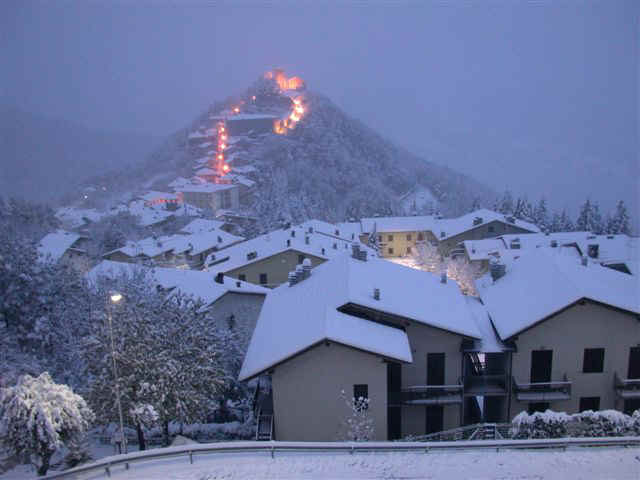
It is an ancient village of 1000 inhabitants that rises 900 meters above sea level on a hill, perched around the church of San Giovanni, which dominates the valley of the Scoltenna stream.
Its municipal territory extends along the right side of the valley and goes as far as the peaks of the Rondinara, Cavrile and Cervarola mountains.
The town is surrounded by centuries-old chestnut, beech and fir woods, in fact the area has a unique woodland heritage: the Montecreto Chestnut Park is one of the most beautiful and evocative green spaces in the Apennines.
Montecreto offers sports facilities of all kinds including, in the locality of "I Fogni" of Acquaria, there are the "treppi" for the throwing of the ruzzolone (traditional sport)
The castle or better"Fortress of Montecreto"it is a medieval fortification whose salient features are still visible today on the top of the mountain at the end of Via Castello. In particular, the building growth scheme of the fortification is based on the keep (the oldest part), still present today, transformed into a bell tower, by several orders of walls that enclose the oldest nucleus (podium della rocca) and the same Via Castello.
Currently, in addition to the keep, the typically environmental aspect remains as from it you can see the surrounding castles and towers that used an ancient cross-sighting system for enemies.
On the“podium”of the fortress there is also the Parish Church of S. Giovanni Battista, renovated in the seventeenth century, hiding an older construction; inside you can see many works of art such as the column-bearing lions that supported the piers of the portal of the fortress (14th century), the baptismal font of the Tuscan school (16th century), the arch and the fresco of the destroyed Oratory of S.Rocco (16th century), the sandstone pulpit of the Tuscan school (16th century), the medieval crucifix of the Tuscan school (14th - 15th century) and some interesting altarpieces on which stands out a painting by Ascanio Magnanini, a 16th century Fananese painter.
THE FORTIFIED MEDIEVAL ROAD
The road that leads from the square to the site of the ancient medieval fortress represents a unique example of a fortified nucleus in the whole of Frignano where the same houses, leaning against each other, form a true impenetrable curtain.
The road that leads from the square to the site of the ancient medieval fortress represents a unique example of a fortified nucleus in the whole of Frignano where the same houses, leaning against each other, form a true impenetrable curtain.
THE MONASTERY
The monastery of Montecreto is an interesting construction dating back to the sixteenth century, it is composed of a central nucleus that runs along the road, an internal garden and a circle of walls (which partially incorporate the walls of the medieval fortress), in the center of which there is an interesting "calvary" (cross with the symbol of Christ's passion) protected within a large shrine.
CASA BORRA
The monastery of Montecreto is an interesting construction dating back to the sixteenth century, it is composed of a central nucleus that runs along the road, an internal garden and a circle of walls (which partially incorporate the walls of the medieval fortress), in the center of which there is an interesting "calvary" (cross with the symbol of Christ's passion) protected within a large shrine.
At the center of the roofs a dovecote tower stands out with a sandstone curb that divided the rooms below from the colobaia itself.
At the center of the roofs a dovecote tower stands out with a sandstone curb that divided the rooms below from the colobaia itself.
At the center of the roofs a dovecote tower stands out with a sandstone curb that divided the rooms below from the colobaia itself.
At the center of the roofs a dovecote tower stands out with a sandstone curb that divided the rooms below from the colobaia itself.
LIONS BRIDGE
The construction dates back to the first half of the eighteenth century as the previous medieval bridge (located slightly further upstream) had been destroyed by a flood of the Scoltenna; the construction entirely in sandstone preserves four interesting sandstone “masks”, walled up on the bridge pillars also in this case as a symbolic projection of the bridge against the floods of the river itself.
The construction dates back to the first half of the eighteenth century as the previous medieval bridge (located slightly further upstream) had been destroyed by a flood of the Scoltenna; the construction entirely in sandstone preserves four interesting sandstone “masks”, walled up on the bridge pillars also in this case as a symbolic projection of the bridge against the floods of the river itself.
ARCHAEOMINERARY AREA OF VIA LASTRANERA
On the top of two ophiolite domes that present at the end of Via Lastranera there are some galleries in which cupriferous materials (copper) were extracted, extracted during the Second World War. Some traces of a metallurgical furnace from the Roman era confirm the presence of mining activities dating back to the 2nd century AD. CHURCH OF S.GEMINIANO and HISTORICAL RURAL NUCLEUS (Magrignana) The medieval village of Magrignana preserves notable examples of historic rural architecture (portals, coats of arms, sandstone tiles, oratories) that unequivocally mark its great historical importance between the fourteenth and sixteenth centuries .
In particular, the seventeenth-century church of San Geminiano, in addition to the fine wooden ceiling and the slender bell tower, preserves two notable Romanesque sandstone columns (the only remains of the destroyed Romanesque parish church of San Geminiano).
In particular, the seventeenth-century church of San Geminiano, in addition to the fine wooden ceiling and the slender bell tower, preserves two notable Romanesque sandstone columns (the only remains of the destroyed Romanesque parish church of San Geminiano).